If you run a facility that stores other people's cars, you already know the awkward truth about the software side of it: there isn't any. Self-storage platforms treat a Porsche as a unit with a door on it. Workshop systems assume the vehicle is there to be repaired and then leave. Neither of them has a concept of a battery tender, a monthly engine start, a bay number, or an owner who would like to know how their car is doing.
So the work ends up spread across whatever is at hand. A spreadsheet for what is stored where. Paper condition forms in a drawer. Arrival photos in a folder on someone's phone. Client requests arriving by WhatsApp, email and phone call, depending on the client. A wall calendar for collections.
That works, right up until it doesn't — usually the day someone asks what a car looked like when it arrived eight months ago, and the answer depends on which staff member is on shift.
We have been building a platform for exactly this problem. It is called CarMarket24, it is developed in-house by our studio, and it is currently in development with a small pilot programme of early operators.
What the platform actually is
CarMarket24 is vehicle storage management software: one system covering intake, bay allocation, recurring vehicle care, client requests, an owner-facing portal, and a daily operations view.
The design principle is boring and deliberate. Every stage of a vehicle's stay writes to the same record. Arrival, storage location, each care task, each owner request, preparation, release. Nothing has to be reconstructed later from photographs and memory, because the record was never split up in the first place.
Here is the operations view a facility manager would open in the morning.
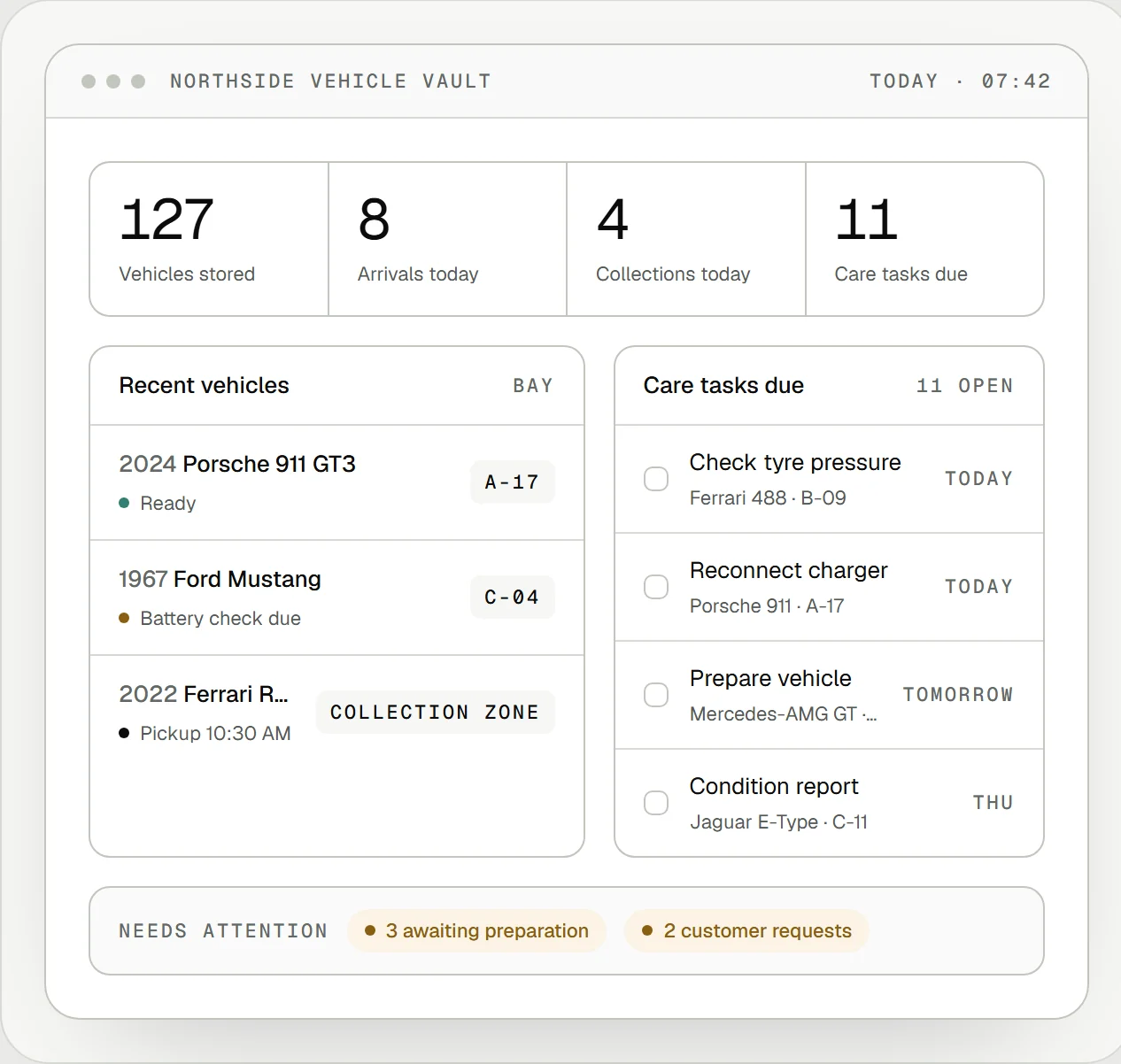
Arrivals today, collections today, care tasks due, and a short list of what needs attention before anyone has to go and ask. That is the whole ambition of the dashboard: replace the morning walk-around and the three phone calls it usually takes to work out what today looks like.
Intake: settle the condition question on day one
Almost every serious dispute in vehicle storage comes back to the same argument — what the car looked like when it arrived.
The defence against that is a thorough check-in, and the reason thorough check-ins do not happen is that they are slower than rushed ones. So the intake flow is built to make the complete version the fast version: photographs, damage points, odometer, fuel level, keys and documents, all captured against the vehicle record rather than into a phone gallery, with the receiving staff member recorded automatically.
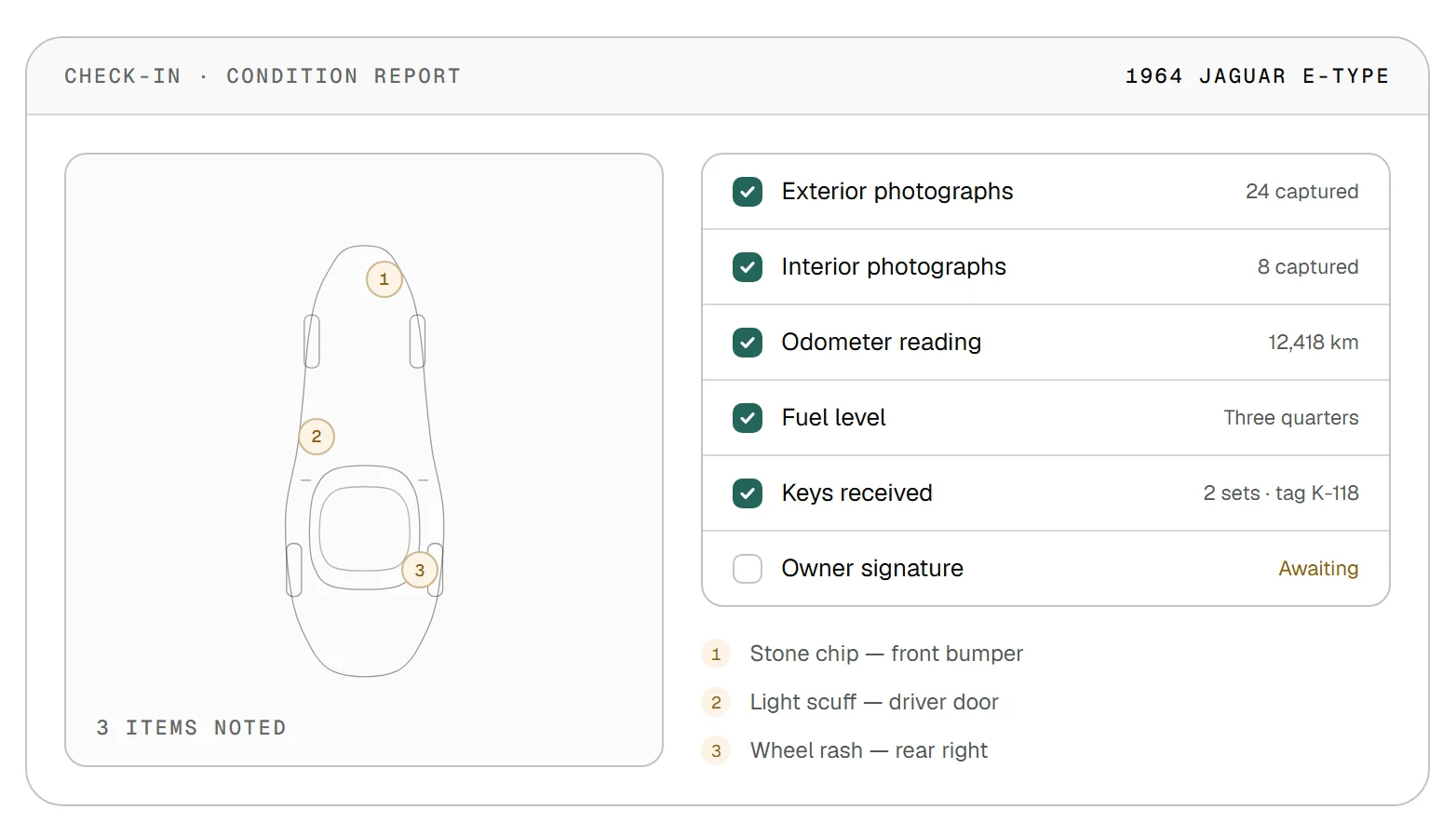
The output is a condition report that exists before the car ever reaches its bay, and that stays attached to the vehicle for the rest of its stay.
Facility visibility: know where every car is
The second thing that scales badly is knowing where things are. Ten vehicles fit in someone's head. Eighty do not, and the moment your bay map lives in one person's memory, that person can never take a day off.
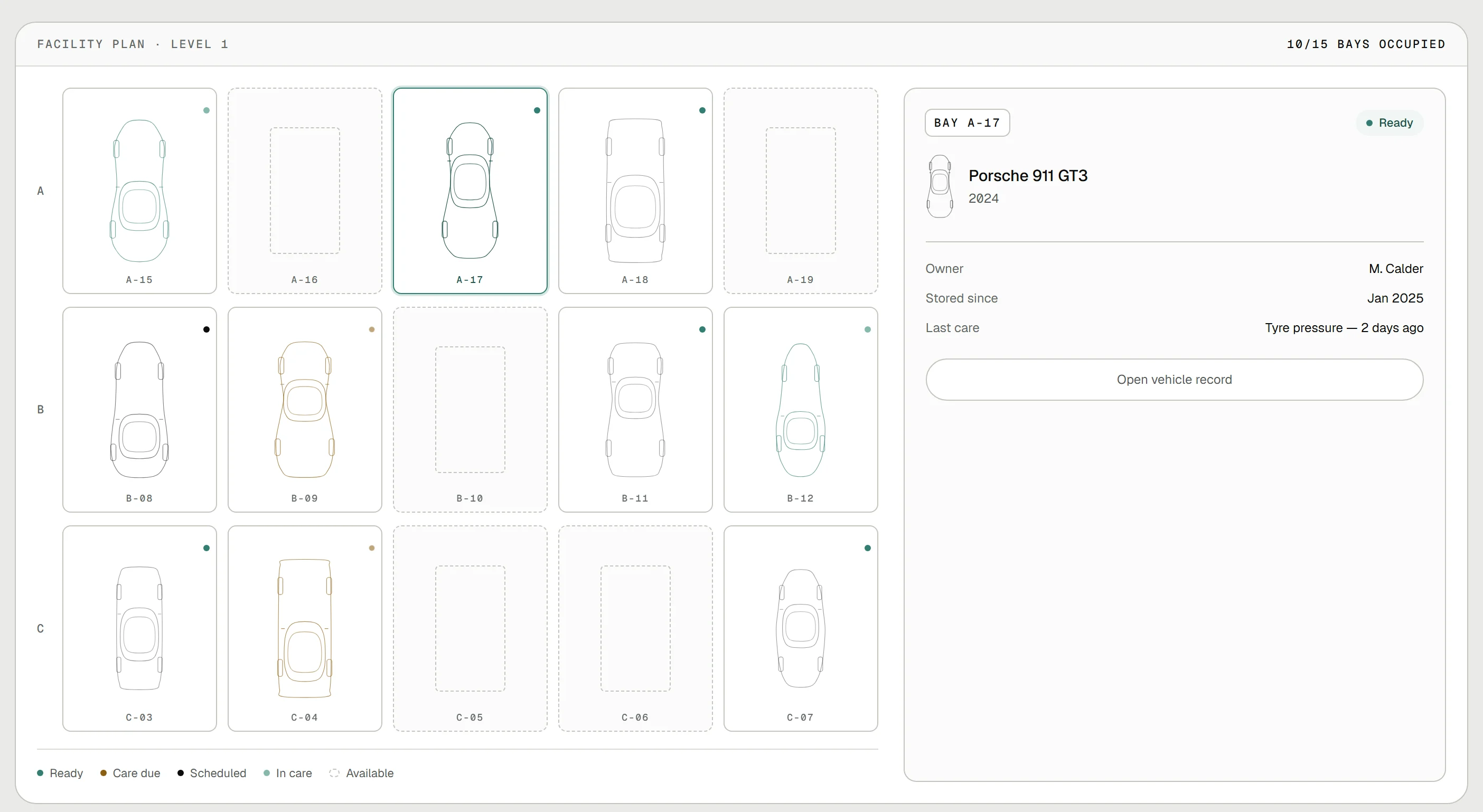
A live plan of the facility, with occupancy and status per bay, means locating a car stops depending on who is rostered on. Select a bay, get the vehicle, the owner, how long it has been stored and when it was last cared for.
Care that is scheduled, not remembered
This is the part that separates vehicle storage from parking. A stored classic needs battery attention, fluid checks, engine starts, tyre pressure, and periodic cleaning — on a recurrence that varies per vehicle and per owner agreement.
In CarMarket24 those become scheduled tasks with an owner, a due date and a completion record, so the care history reads as evidence rather than assurance: what was done, when, and by which staff member. That record is the thing owners are really paying for, and until now it has mostly been invisible to them.
The customer portal is the commercial argument
Storing someone's car is a trust business, and trust is currently being delivered by text message.
A private portal gives each owner their vehicle's current status, its bay, recent photography from the floor, the full condition and care history, and a way to request collection or preparation without ringing your office. It reduces the administrative load on your team while quietly separating you from every operator still sending photos from a personal phone.
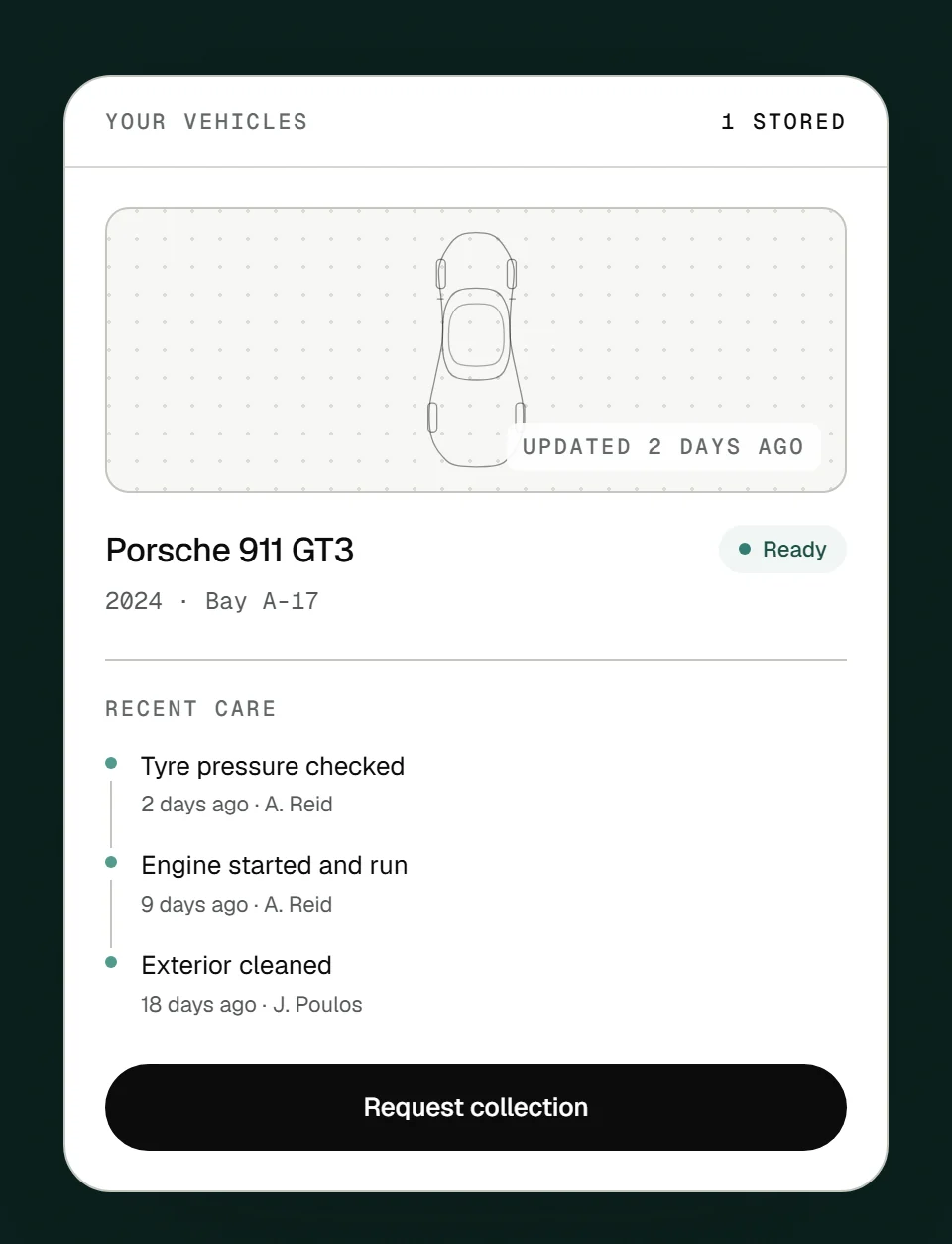
For most facilities this is the feature that pays for the software, because it is visible to the customer. It is the difference between "your car is fine" and a record they can look at themselves at eleven o'clock at night.
Who we built it for
CarMarket24 is deliberately narrow. It is for businesses holding vehicles that cannot simply be parked and forgotten about:
- Prestige and climate-controlled storage — high-value modern vehicles, owners who expect precision
- Classic car storage — long-term stays where battery, fluid and engine-start routines genuinely matter
- Collector facilities — multi-vehicle collections needing per-vehicle history and internal accountability
- Automotive concierge businesses — coordinating detailing, servicing and transport on an owner's behalf
- Private and discreet facilities — where owner privacy and accurate records are non-negotiable
If your operation is a paddock of cars with no service obligation attached, this is not for you, and we would rather say so now.
Where it is up to
CarMarket24 is pre-launch. We are not going to quote results we have not measured, so there are no percentages in this article and none on the product site either. What exists today is a working direction, built with a small number of early operators whose day-to-day problems become the roadmap.
The pilot programme is open. Early operators get access as the platform is built, direct contact with the people writing the software rather than a support queue, and preferential pricing at general availability. If you run a premium, classic or specialist storage facility, the pilot page is the place to start — we mostly want to understand how your facility runs today.
Why a web studio built vehicle storage software
Because we do this regularly, and it makes us better at the client work.
CarMarket24 sits alongside the other tools we have shipped ourselves — invoicing platforms, an auction platform, a 5G planning suite, HR software and six Android apps, all listed on our products page. Building and maintaining our own software is what keeps us honest about performance budgets, privacy decisions and what software actually costs to own after launch.
It also means that when a client comes to us with an operational mess held together by spreadsheets and goodwill, we have built the alternative rather than just specified it. If that sounds like your business, our web application development work starts the same way this did: understanding how the operation actually runs, then removing the tools that were never designed to work together.
Have a look at CarMarket24, or get in touch if you want to talk about software for your own operation.
Frequently Asked Questions
What is vehicle storage management software?
It is software built specifically for facilities that store vehicles on behalf of owners, as opposed to self-storage or workshop software. It covers vehicle intake and condition reporting, bay allocation, recurring care schedules such as battery and engine starts, client requests, and a record of everything done to each vehicle during its stay.
Who is CarMarket24 for?
Premium, classic and specialist vehicle storage operators — prestige and climate-controlled facilities, classic car storage, collector facilities, automotive concierge businesses and private storage operations. It is built for vehicles that need active care while stored, not for general parking.
Is CarMarket24 available now?
Not yet. It is in active development and currently selecting early operators for a pilot programme. Pilot operators get access as the platform is built, influence over the roadmap, direct support from the development team, and preferential pricing when it becomes generally available.
Why not just use self-storage or workshop software for a car storage facility?
Self-storage software models a unit with a door, not a vehicle with a condition report, a bay, an owner and a care schedule. Workshop software assumes the vehicle arrives for a job and then leaves. Neither handles long-term custody, recurring care, or an owner who wants visibility of a car they are not driving.
Who builds and maintains CarMarket24?
Blu Mint Digital, a Melbourne digital studio. We build and maintain the platform end to end, which is why pilot operators talk directly to the people writing the software rather than to a reseller or a support queue.